
Downtown Mafia: Gang Wars Game
DYNAMICNEXTRole Playing
4.5647.00 Reviews
- Version
- 0.9.40
- Installs
- 5.00M
- Age Rating
- Teen
Screenshots
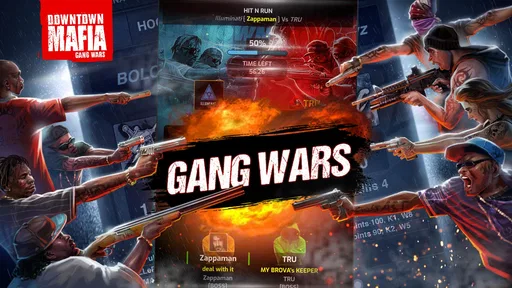

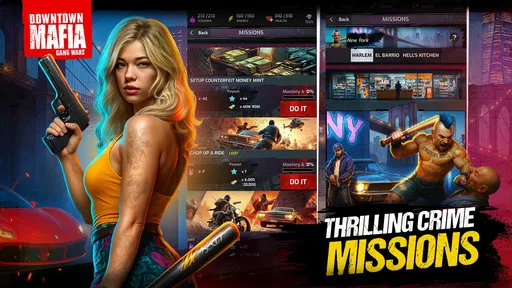
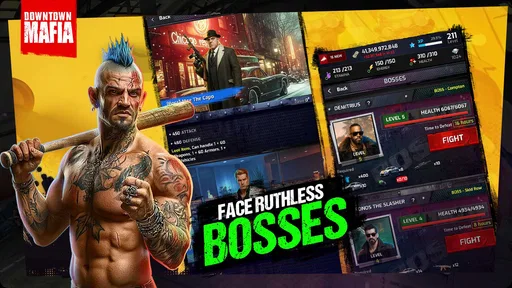
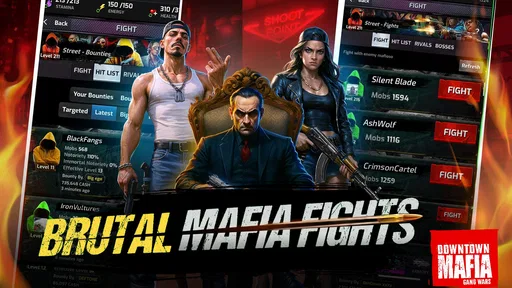

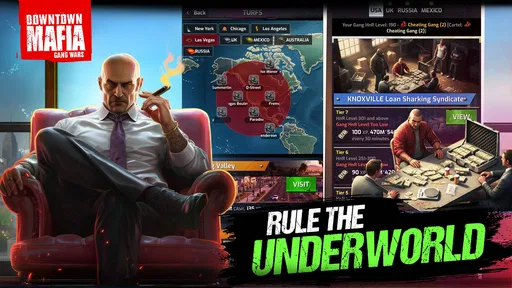
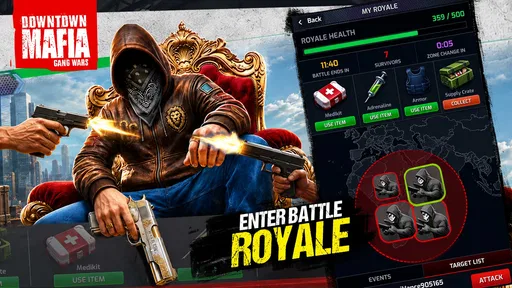
Our Review of Downtown Mafia: Gang Wars Game
 Analysis by Appyee
I approached Downtown Mafia: Gang Wars Game as a role-playing game built around short decisions rather than long action sessions. Its text-led format immediately sets the tone: you spend your time reading options, choosing actions, checking progress, and returning when you have a moment. That makes it a very different experience from a visually busy crime game or a traditional real-time RPG. I found it most appealing when I wanted a persistent mafia-themed game that could fit around ordinary parts of the day.
The game comes from DYNAMICNEXT and is free to start, with optional in-app purchases ranging from $0.99 to $99.99 per item. It is marked for Teen audiences, and the current version is 0.9.40. The long-running nature of the release is reflected in its launch date, October 2, 2012, while its audience remains substantial: it has passed 5 million installs and holds a 4.5 average from around 4.3 thousand ratings. Those figures suggest a well-established niche, but they do not change the basic truth of the experience: this is a text-heavy, menu-driven mafia RPG, and you need to enjoy that rhythm for it to work.
How the text-first design affects readability and navigation
I focus here on how a text-first interface shapes the moment-to-moment experience, beyond simply making play slower. In particular, I’ll look at how reading and choosing can help players stay oriented—and where the same approach asks for extra care. That sets up a closer look at the practical routines that make navigation feel manageable.
A game that asks you to read before you act
The clearest strength is also the feature that will decide whether you stay. Instead of relying on constant animation or complex visual maps, the game presents its world through written information and selectable actions. I found that approach calmer than the usual mobile crime games, especially when I was playing in short bursts. The important habit is to read each screen instead of tapping through automatically, because the value of a choice depends on what the game is asking you to manage at that moment.
For players who prefer written instructions, this can be easier to follow than a crowded action interface. A text-based layout gives the player time to process the situation and decide what to do next. It also reduces the pressure to react instantly. I could stop, reconsider an option, and return to the same kind of planning without feeling that I had missed a fast-moving event.
That benefit has a limit. Text-heavy games can become tiring when several screens contain similar-looking information. If you have difficulty tracking small differences between labels, costs, rewards, or status details, a quick tapping style may lead to mistakes. My practical advice is to slow down when a decision affects progress or resources. Treat each menu as a planning screen, not as a button sequence.
Navigation rewards a deliberate routine
I found the game easier to understand once I created a simple routine: check the current objective, review available actions, choose the activity that fits my available time, and then look at progress before leaving. This matters because an idle-oriented RPG can tempt you to open every option at once. Doing that makes the game feel more complicated than it needs to be.
A useful approach is to separate “now” decisions from “later” decisions. If I only had a minute, I focused on the immediate action and left deeper planning for a longer session. If I had more time, I compared several choices instead of accepting the first available option. This workflow is especially helpful for readers who find dense menus mentally tiring: one goal at a time keeps the criminal empire theme from turning into a pile of disconnected tasks.
The social MMORPG side also changes how navigation feels. The game is not only a private progression loop; its identity includes interaction with other players. That can make the world feel more alive than a solitary text adventure, but it also means that some of the experience depends on keeping track of social activity as well as personal progress. Players who want a completely self-contained campaign may find the broader structure less comfortable than a single-player role-playing game.
Where the presentation may challenge different readers
Text-first design can support people who dislike flashing effects, busy combat scenes, or rapid visual changes. It is also better suited to players who prefer to read at their own pace. However, readable content is not only about having words on a screen. Contrast, text size, spacing, and the amount of information presented together all affect comfort, and those details can feel more important here because reading is the main way the game communicates.
If you use a phone with a smaller display, I would test the game during a relaxed session before committing to it. A screen that feels comfortable for a quick message may be less comfortable when you are repeatedly comparing written choices. Players who rely on device-level magnification or other visual adjustments should also check whether those tools remain practical during navigation, since enlarging content can make it harder to see the surrounding controls at the same time.
Motor and sensory considerations during play
From a motor perspective, the game is less demanding than a real-time fighting or racing title. You are not expected to aim, swipe rapidly, or coordinate several on-screen controls during a fast encounter. That makes it a reasonable option for someone who prefers slower interaction and needs more time between taps. I could play while tired without the physical strain that often comes from action-heavy mobile games.
The trade-off is that repeated menu selection can still become inconvenient. If tapping small controls is difficult, or if you need to avoid long sessions of repetitive phone use, the game is best approached in short visits. The idle structure helps here: you do not need to remain in the game continuously to get value from the format. I would use a brief check-in pattern rather than trying to complete everything in one extended sitting.
For sensory comfort, the text-led presentation is potentially gentler than games built around constant explosions, rapid camera movement, or loud combat feedback. That does not make it universally comfortable, because individual settings and device behavior differ, but the core design does not depend on visual spectacle. If you are sensitive to overstimulation, this slower presentation may be one of its more attractive qualities.
At the same time, a quiet interface can be less engaging for players who need strong visual or audio cues to understand what is happening. If you depend on animation, color changes, or prominent effects to distinguish one state from another, a written menu may require more concentration. In my experience, the game communicates best when I am willing to read carefully; it is not ideal for someone looking for information to be obvious at a glance.
Playing in real-life situations
The strongest everyday use case is the small gap in a normal schedule. I could imagine opening it during a commute break, while waiting for an appointment, or after finishing a short household task. Because the design is based on decisions and progression rather than continuous action, it fits those moments better than a game that punishes you for putting the phone down. I would still avoid playing while walking, driving, or doing anything that requires attention elsewhere.
It also works for players who like a game to remain part of their routine without demanding a large uninterrupted block of time. A quick visit can be useful for checking progress, while a longer session can be reserved for social activity and planning. That flexibility is more meaningful than simply calling the game “casual”: the mafia RPG structure gives short sessions a purpose, rather than making them feel like incomplete attempts at a much larger console-style experience.
There is a social-context issue, though. The Teen content rating means parents and younger players should treat the game as intended for older children and above, not as a family-friendly title for every age. The mafia theme may also be a poor fit for anyone who dislikes criminal settings, competitive social play, or the tone associated with gang-based role-playing. I would not recommend it solely because it is text-based; the subject matter still matters.
How it compares with other mobile role-playing choices
Compared with an action RPG, this game gives up spectacle and immediate control in exchange for patience and planning. You will not choose it for elaborate combat animations or reflex-based gameplay. Compared with a conventional story RPG, it is less about following a tightly authored journey and more about maintaining progress through repeated choices and a continuing social world.
It also differs from many idle games that reduce interaction to collecting rewards and upgrading automatically. Here, the mafia setting and role-playing structure give the waiting period a stronger identity. You are not simply watching numbers rise; you are returning to a criminal-world framework and deciding what to do next. That said, players who want a highly guided narrative may prefer a story-focused RPG, while players who want immediate excitement may be happier with a combat-centered alternative.
The best comparison is therefore not “better or worse,” but “what kind of attention do you want to give?” I would choose this game for written decision-making, persistent progression, and social atmosphere. I would choose another role-playing game if I wanted rich graphics, voice acting, direct character movement, or a campaign that reaches a clear ending without requiring regular return visits.
Practical friction and spending choices
Because the game is free to download and play, the first barrier to trying it is low. The more important question is how comfortable you are with optional purchases. Items range from $0.99 to $99.99, which is a very wide spread. I recommend deciding on a personal spending limit before getting deeply involved, especially if the progression loop makes you feel that a purchase would save time or improve your position.
This is not a criticism of every purchase in itself. Optional spending can be reasonable for someone who enjoys a game and wants to support it. The friction appears when a player starts treating purchases as part of the normal cost of keeping up. My approach would be to play long enough to understand the basic progression before spending anything, then ask whether the purchase adds enjoyment or merely removes waiting.
Another limitation is the possibility of repetition. Text-based idle role-playing depends on returning to familiar categories of action, and that can feel satisfying for a routine-oriented player but dull for someone who needs constant novelty. I enjoyed the low-pressure rhythm in short sessions, yet I would not pretend that the format has the same variety as a large, visually driven RPG. Its appeal comes from persistence and choice, not from continually changing scenery.
Who will get the most from it
I think the game suits readers who enjoy mafia fiction, menu-based role-playing, and progress that continues between visits. It is particularly appropriate for someone who wants to play with one hand, take time over decisions, and avoid the physical demands of fast action. The social MMORPG element is another reason to try it if you like seeing your progress in relation to other players rather than staying entirely alone.
It is less suitable for players who need large visual targets, quick feedback, or a strongly cinematic presentation. I would also suggest skipping it if you dislike idle mechanics, competitive social environments, or the possibility of spending pressure. Someone looking for a short, fully completed story should choose a different kind of RPG, because this experience is built around ongoing participation rather than a single finish line.
For families, the Teen rating should be taken seriously when deciding whether it belongs on a shared device. For people with visual, motor, or attention-related needs, the slower pace may help, but the text and menu density can still create obstacles. I would judge it through a short personal trial: check whether the writing is comfortable to read, whether the controls are easy to select, and whether the amount of information feels manageable on your device.
My inclusive verdict after using the game
What I appreciate most is that Downtown Mafia does not require the player to perform at speed. Its text-based role-playing format creates room to pause, read, and choose, which can make it more approachable than action-heavy alternatives in everyday situations. The idle structure also supports short sessions, and the social layer gives the long-term progression more personality than a simple offline checklist.
Its accessibility is not automatic, though. A slower game can still be difficult when the screen is crowded, the text is tiring, or repeated tapping becomes uncomfortable. The strongest experience comes to people whose needs match deliberate reading and menu navigation. I would not present it as the right choice for every ability or context; I would present it as a game worth testing when controlled pace matters more to you than visual drama.
After weighing those strengths and barriers, I see it as a focused recommendation rather than a universal one. If you want a free-to-start mafia MMORPG that can occupy brief gaps in the day, rewards patient planning, and does not rely on reflexes, it is easy to understand why the game has maintained a large audience. If you want a polished action adventure, a linear story, or an interface that communicates everything through obvious visual signals, another role-playing game will serve you better.
My final advice is simple: start slowly, read before tapping, keep purchases intentional, and pay attention to how your device handles the text. If that rhythm feels comfortable, this is a surprisingly practical choice for low-pressure, ongoing role-playing. If it feels like work after a few sessions, the problem is probably not your patience; the format is simply not aligned with the way you want to play.
Verdict
Strengths of Downtown Mafia: Gang Wars Game
- Strategic territory control adds depth beyond simple combat.
- Short missions make it easy to play during quick breaks.
- Distinct gang units encourage experimenting with different tactics.
- Progression rewards regular play without requiring long sessions.
- The urban setting gives the game a recognizable crime-drama atmosphere.
Limitations of Downtown Mafia: Gang Wars Game
- Energy limits can interrupt play when you want longer sessions.
- Some upgrades may take considerable time to complete.
- Battles can feel repetitive after mastering the main strategies.
- The interface may seem crowded for new players at first.
- A stable internet connection may be needed for key features.
Other Releases by DYNAMICNEXT
View All
Texas Holdem - Poker Legends
Card4.4
Similar Picks in This Category
View All
Hair Dye
CrazyLabs LTD4.4

Monster High™ Beauty Salon
CrazyLabs LTD4.5

Bus Simulator - Bus Games 3D
Jima Apps4.4

Flight Pilot: 3D Simulator
Wildlife Studios4.1


Super Stylist Fashion Makeover
CrazyLabs LTD4.4
Frequently Asked Questions
What is Downtown Mafia: Gang Wars about?
Downtown Mafia: Gang Wars is a crime-themed strategy and management game focused on building a powerful underground empire. You typically recruit and upgrade gang members, control territory, complete missions, collect resources, and compete against rival groups. The game combines city expansion, tactical decisions, and progression systems, so it is better suited to players who enjoy long-term planning than those looking for a simple action game.
Can I play Downtown Mafia: Gang Wars offline?
The game appears to be designed primarily as an online experience, especially for features involving rival gangs, events, rankings, cloud progress, or multiplayer interaction. Some single-player activities may load under limited connectivity, but a stable internet connection is generally recommended for the complete experience. Before downloading, players should also check the store listing because offline availability and online requirements can change with updates.
Is Downtown Mafia: Gang Wars free to download and play?
Downtown Mafia: Gang Wars can generally be downloaded without an upfront purchase, but free access does not necessarily mean that every feature is completely free. Like many strategy games, it may include optional in-app purchases for premium currency, faster upgrades, special offers, or additional resources. You can make progress without spending money, although patience and regular play may be required to keep pace with players who purchase upgrades.
Does the game contain ads or in-app purchases?
Players should expect the possibility of advertising and optional in-app purchases. Advertisements may be offered in exchange for bonuses or may appear during certain parts of the game, while purchases can help speed up construction, recruitment, or resource collection. If children use the device, parental controls and purchase restrictions are advisable. Reviewing the current Google Play or App Store details is the safest way to confirm the latest monetization policy.
What devices are compatible with Downtown Mafia: Gang Wars?
Compatibility depends on the Android or iOS version, available storage, and the device’s hardware. Newer phones and tablets should provide a smoother experience, particularly during busy city scenes, battles, or online events. Before installing, check the official store page for the required operating-system version and available space. It is also wise to keep extra storage free because updates may be larger than the initial download.
Play our best games!


